Expo 2030 opens the decade. The centennial closes it. In between, the world will read the Kingdom through the objects it creates: what we make, how we make it, and what it says about who we are. In this lab, your teams design and build those objects by hand, then trace every decision between now and 2032 that makes them real. Plus a published Field Note in the GBOX Futures Observatory.
A tactile snapshot of participant artifact designs, reverse decision timelines, and carbon border stress-tests generated during the sprint:
Watch the simulation prologue: exploring how tangible speculative design, reverse decision timelines, and material systems will author the Kingdom's story at one hundred.
The essential parameters that define the centennial horizon and anchor every design sprint:
Nobody visits a museum to see a strategy document. They come to see objects: the craft, the calligraphy, the design language of a moment. The centennial will be told through artifacts, and the institutions that make them will author the story.
By 2032, what an object is made of and what it cost the earth will be part of its beauty. Europe already prices the carbon built into goods crossing its border. The artifacts worth making are the ones that carry their footprint proudly, in circular materials and honest making.
When the world arrives in Riyadh, every pavilion is an argument made physical. Institutions that learn to think in artifacts now will know exactly what to place on that stage.
A structured 2-day simulation journey taking cohorts from reverse design to physical exhibition:
Teams design an artifact that exists in 2032 and carries meaning: a product that blends heritage craft with new material science, a graduate's certificate, a museum piece, an object worthy of a pavilion shelf. Vague visions get sent back. Objects get made.
For this object to exist in 2032, what had to be true in 2030? Decided by 2028? Started this year? Every link becomes a decision with an owner and a date. Ambition turns into a chain you can hold.
Each artifact faces the honest questions: its materials, its carbon story, its cost at borders that now price emissions, its cultural truthfulness. Weak links get redesigned on the spot. An artifact that survives this stage deserves to exist.
Teams fabricate their artifacts with real materials and digital tools. The finale is an exhibition: leadership walks the room, holds the objects, and reads the story and decision chain attached to each one. Futures work you can put on a table.
After every lab, GBOX publishes a Field Note: a designed, credited record of what your room imagined and built. It enters the GBOX Futures Observatory, our growing body of foresight intelligence across the region.
The artifacts tend to outlive the lab too, ending up in lobbies, majlis corners, and classrooms as standing reminders of the commitment made.
Explore Published Field Notes →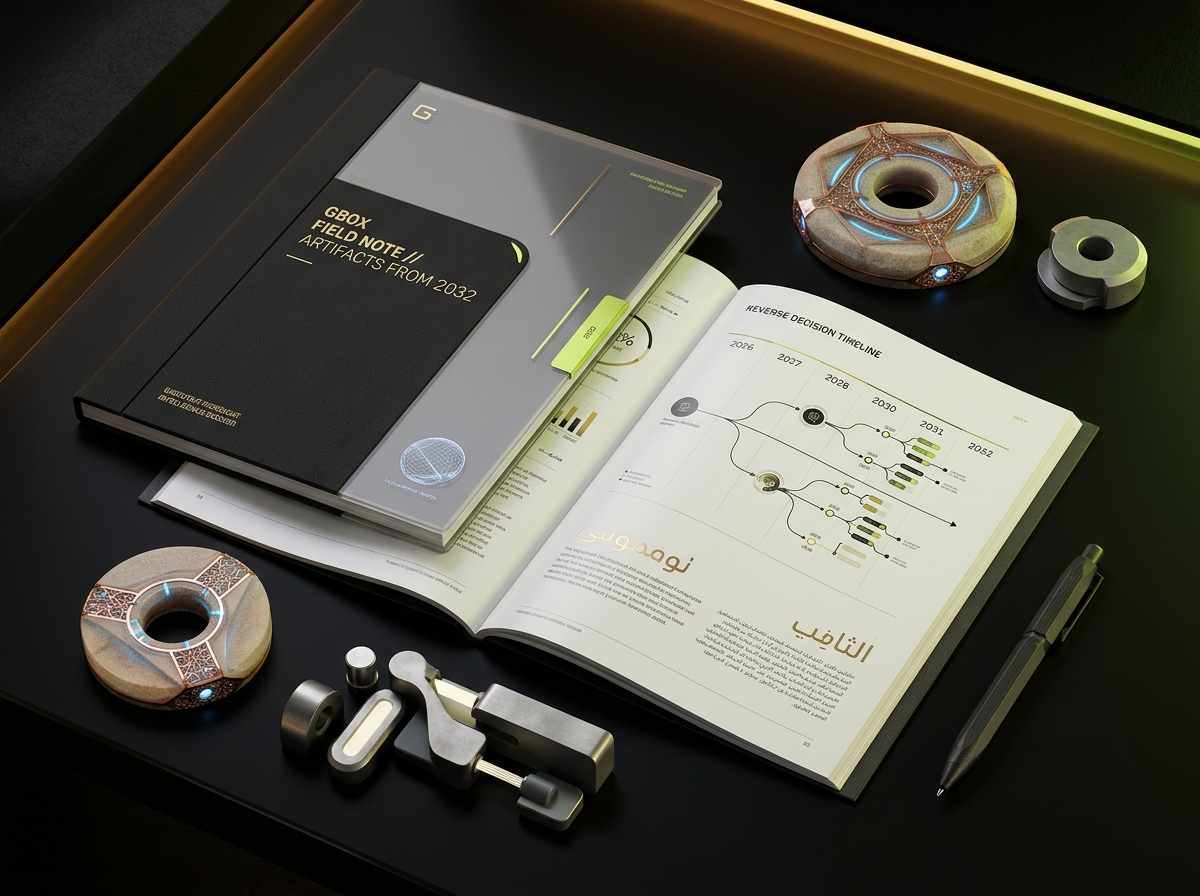
Designed to deliver distinct, measurable value across every level of your institution:
Leaders get ambition converted into dated, owned decisions, plus a physical object that keeps the commitment visible long after the offsite ends.
Teachers get the most human futures method there is: making things with meaning. Templates scale down to a single class period of project-based learning, connecting art, science, and heritage in one project.
Students get to design the centennial from the inside and hand a built artifact to real decision-makers. You will be mid-career in 2032. This is your evidence that you helped author it.
Two consecutive days, on site or at a partner venue. Fifteen to thirty participants, mixed seniority by design. English, Arabic, or bilingual. Fully facilitated, fabrication materials and digital tools included, Field Note published after.
